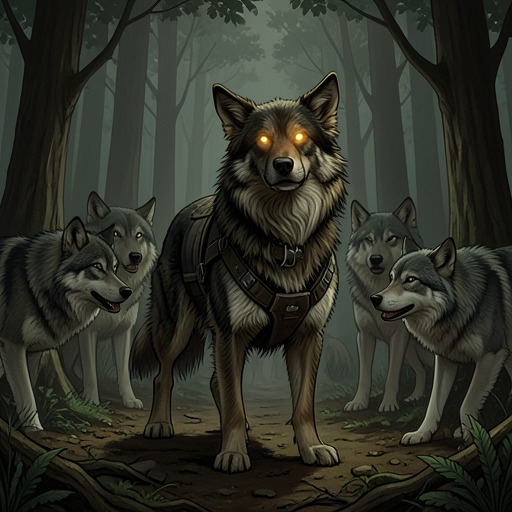
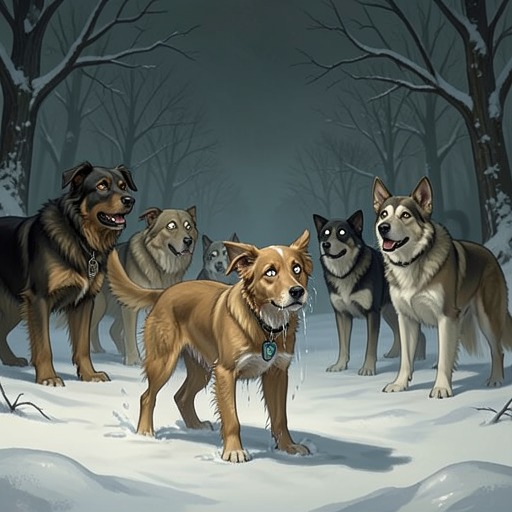
Curly
The Call of the WildCurly is a good-natured Newfoundland acquired alongside Buck for the Canadian Government’s northern dispatch service. Her brief career in the team ends in a savage kennel attack, but her death becomes one of the decisive formative experiences in Buck’s transformation: it reveals that the northern dogs obey no humane code of fair combat, and that falling once can mean death.\n\n## Identity and Introduction\nCurly is introduced as a Newfoundland and as a companion to Buck when both dogs are purchased from the man in the red sweater. They are led away together, see Seattle recede from the deck of the Narwhal, and leave the warm Southland behind. Perrault and Francois take charge of them, bringing them below deck and placing them among other dogs destined for work in the North.\n\nCurly’s defining quality is her friendliness. She approaches the northern world in a good-natured, open manner, carrying into the camp a social instinct that has not yet been disciplined by the violence of the trail. The contrast between her temperament and the environment is crucial: the people and dogs around her are not town dwellers, but creatures who recognize the law of club and fang.\n\n## Life in the Team\nCurly enters the sled-dog system with Buck and is part of the expanding team that soon numbers nine dogs. The team’s work is governed by harness, command, correction, and coordinated effort. Buck gradually learns to stop at “ho,” move ahead at “mush,” swing wide on bends, and avoid the wheeler when a loaded sled rushes downhill; Curly belongs to this same working community, where survival depends on adapting quickly to the traces.\n\nThe team’s labor also reveals a social order unlike the domestic life Buck once knew. Harnessing awakens the dogs’ alertness and ambition, and the pride of trace and trail turns work into the central expression of their being. Curly’s fate comes before Buck has fully absorbed this order. Her friendliness is not merely a personal trait; it marks the vulnerability of a dog still applying the assumptions of civilized companionship to a setting organized by dominance and sudden violence.\n\n## Attack and Death\nCurly is killed near a log store after making friendly advances to a husky dog as large as a full-grown wolf, though not half so large as Curly herself. The attack gives no warning. The husky leaps in, tears Curly’s face from eye to jaw, and leaps away with the rapid, metallic precision characteristic of wolfish fighting.\n\nCurly repeatedly rushes her antagonist, but the husky meets her next charge with its chest and knocks her from her feet. That instant determines the outcome. Thirty or forty huskies have gathered in a silent, intent circle, licking their chops and waiting for Curly to go down. Once she falls, they close upon her, snarling and yelping, and bury her beneath a bristling mass of bodies.\n\nFrancois responds with an axe, assisted by three men carrying clubs, and drives the dogs away within two minutes. Curly is left limp and lifeless in the bloody, trampled snow, almost torn to pieces. The intervention cannot restore her; it only ends the attack and exposes the finality of the rule Buck has just witnessed.\n\n## Effect on Buck\nCurly’s death is a vicarious lesson for Buck, because he survives by watching what happens to her. He learns that this northern violence does not resemble a contest in which strength, courage, or fair play can guarantee survival. The crucial fact is that once a dog is down, the struggle is over. The surrounding pack does not wait for a just conclusion; it waits for vulnerability.\n\nThe scene returns to Buck in troubling sleep. Its repetition in memory gives Curly’s death a continuing presence in his development. Buck resolves never to go down himself, converting horror into vigilance. The lesson also changes how he regards Spitz. When Spitz laughs by running out his scarlet tongue after Curly’s death, Buck begins to hate him with a bitter and deathless hatred. Spitz’s amusement identifies him with the merciless order that destroyed Curly and makes their later rivalry more than a contest for position.\n\n## Narrative Significance\nCurly’s death is the first unmistakable demonstration of the law of club and fang for Buck. It marks the collapse of his earlier expectation that strength and sociability can coexist safely in every environment. Soon afterward, Francois places Buck in harness, and Buck begins the physical and psychological education of a sled dog; Curly’s fate stands immediately behind that education as its warning.\n\nHer death also establishes the difference between domestic identity and working or wild identity. Curly arrives from the Southland as a friendly Newfoundland, but the North judges dogs by alertness, resistance, and the ability to remain standing under pressure. The event therefore has consequences beyond the loss of one team member: it helps initiate Buck’s movement away from civilized assumptions and toward the primitive discipline of the trail.